
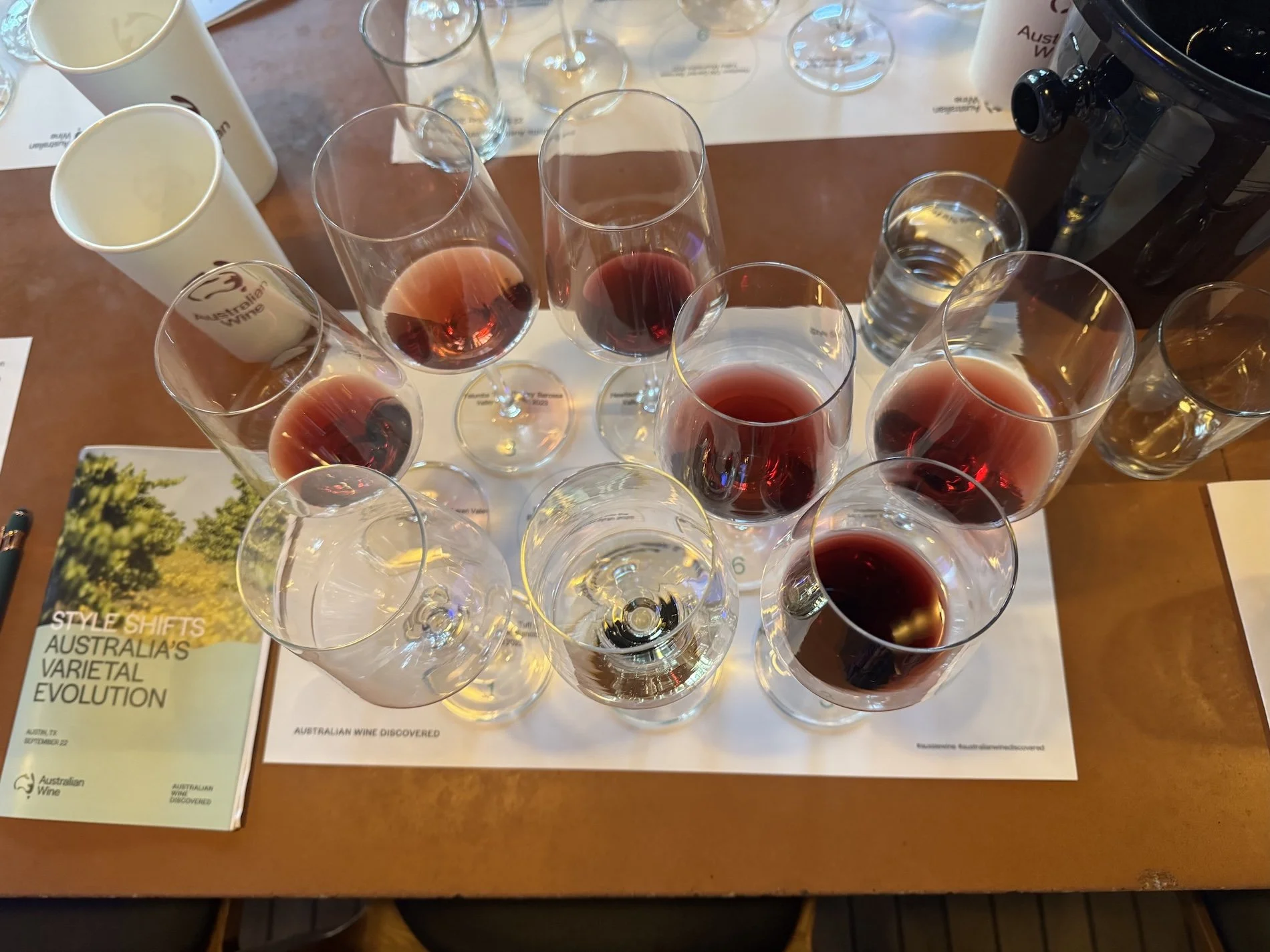
There were three full tables of Grenache in front of me, and I had not expected a single one of them.
I spent the afternoon of September 22nd at Il Brutto in Austin at a seminar called Style Shifts: Australia's Varietal Evolution, led by Mark Davidson, Wine Australia's Head of Education Development for the Americas. Davidson grew up in Sydney, spent fifteen years as a sommelier, and has been teaching people about Australian wine since 2013. He had twenty five bottles to pour and a fairly direct argument to make.
The argument was this. If you can name one Australian grape, it is Shiraz, and that has become a problem for a country that now grows a great deal more than that.
Australia has 65 wine regions and most of us can name one grape
Here is the scale problem in a single number. Australia has roughly 145,000 hectares under vine, which is about 0.02% of the country's total land mass, and roughly the same vineyard area as Bordeaux and Burgundy combined.
That land is spread across 65 distinct wine regions, from maritime to continental to Mediterranean climates, and for most of us the entire thing collapses into one word. Big red. Probably jammy. Probably from the eighties.
The wines in that room were mostly under 14% alcohol, several were under 12%, and a good number of them were Italian.
The Mediterranean grapes quietly taking over
The white flight opened with Fiano, from Campania in southern Italy, made by Oliver's Taranga in McLaren Vale. Fiano arrived in Australia courtesy of the CSIRO in 1978 and was commercially pioneered by McLaren Vale producer Coriole in the early 2000s. As of this year it is the single most planted white grape variety in McLaren Vale.
From there it kept going. Vermentino from the Riverland. Montepulciano, which Davidson described as Abruzzo's workhorse and which Australia is turning into genuinely good Monday to Thursday red wine at around twenty five dollars. Nero d'Avola from Sicily. Dolcetto from Piedmont, of which Australia has planted about 100 hectares total. Mencia, the Spanish grape from Bierzo, which barely registers on Australian planting statistics and which Oliver's Taranga is making anyway.
The reason is climate, and it is not subtle. These are grapes bred over centuries in hot, dry, sunny places with limited water. So is most of South Australia. Growers who spent decades trying to make cool climate French varieties behave in a Mediterranean climate have started planting grapes that were built for one.
What surprised me is how old this idea actually is. Several of these varieties appear on James Busby's 1832 list of vine cuttings imported to Australia. They arrived nearly two hundred years ago, sat quietly for most of that time, and are only now getting their moment.
Why the room was full of Grenache
An entire table of the tasting was Grenache, and then Grenache showed up again across the reds, and by the end I had tasted eight of them.
Here is the statistic that reframes that. Grenache accounts for just 1,507 hectares in Australia, or 1.1% of everything the country plants. I sat in front of three tables of a grape that is barely one percent of Australian vineyards.
It used to be a great deal more. Grenache was one of the first varieties planted in Australia, and the country is home to the oldest Grenache vines in the world, dating to 1848. Through the 1800s and early 1900s it was a workhorse, used for table wine and fortifieds alike. Then from the 1970s its popularity collapsed and the old vineyards started coming out.
Charles Melton is largely why any of them survived. He looked at the old Barossa Grenache vineyards nobody wanted in the seventies and eighties and made his flagship wine from them, a Grenache, Shiraz and Mourvèdre blend called Nine Popes. Since 2000 the rest of the country has caught up, picking earlier, using less oak, and making something lighter and more perfumed.
Davidson called it warm climate Pinot Noir, which after eight of them I think is fair. My favorites were the Tim Smith 'Bugalugs' from Barossa at twenty five dollars and Yalumba's 'Bush Vine', also twenty five, which is grown without wire in the same free-standing style used in Châteauneuf-du-Pape.
When Shiraz decides to call itself Syrah
The most interesting bottle of the day was labeled Syrah.
Shiraz and Syrah are the same grape. Australia has called it Shiraz for well over a century, and that name now carries an expectation with it: big, ripe, jammy, high alcohol. So a handful of Australian winemakers have started putting Syrah on the label instead, specifically to signal that what is inside is leaner and more savoury.
The Worlds Apart 'Into the Black' from McLaren Vale was 12.5% alcohol and tasted like it came from the northern Rhône. It was my favorite red of the afternoon, alongside the Mitolo 'Cinquecento' Sangiovese. That is a sentence I did not expect to write about an Australian tasting.
It also tells you something about how much a word on a label does. If you want the rest of that story, I broke down what a wine label is actually telling you in a separate post, because the name of the grape is only one of five things worth reading.
What Barossa actually means by "old vine"
Most of the wine world throws the phrase "old vines" around with no definition behind it whatsoever. There is no legal standard in most places. A producer can print it on a label because the vines feel old.
Barossa got tired of this and wrote it down. Their Old Vine Charter, established in 2009, sorts vines into four tiers:
Barossa Old Vine: 25 years and older
Barossa Survivor Vine: 70 years and older
Barossa Centenarian Vine: 100 years and older
Barossa Ancestor Vine: 125 years and older
Barossa holds the largest acreage of old vines anywhere in the world, some of it dating to the region's settlement by Silesian farming families in the early 1840s. We tasted two wines well past the Ancestor tier. The Yalumba 'Tricentenary' Grenache comes off a vineyard planted in 1889 and spent 333 days on skins, and I wrote "weird taste, licorice?" in my notes, which I stand by. The Hewitson 'Old Garden' Mourvèdre comes off vines planted in 1853, widely considered the oldest Mourvèdre vineyard on earth.
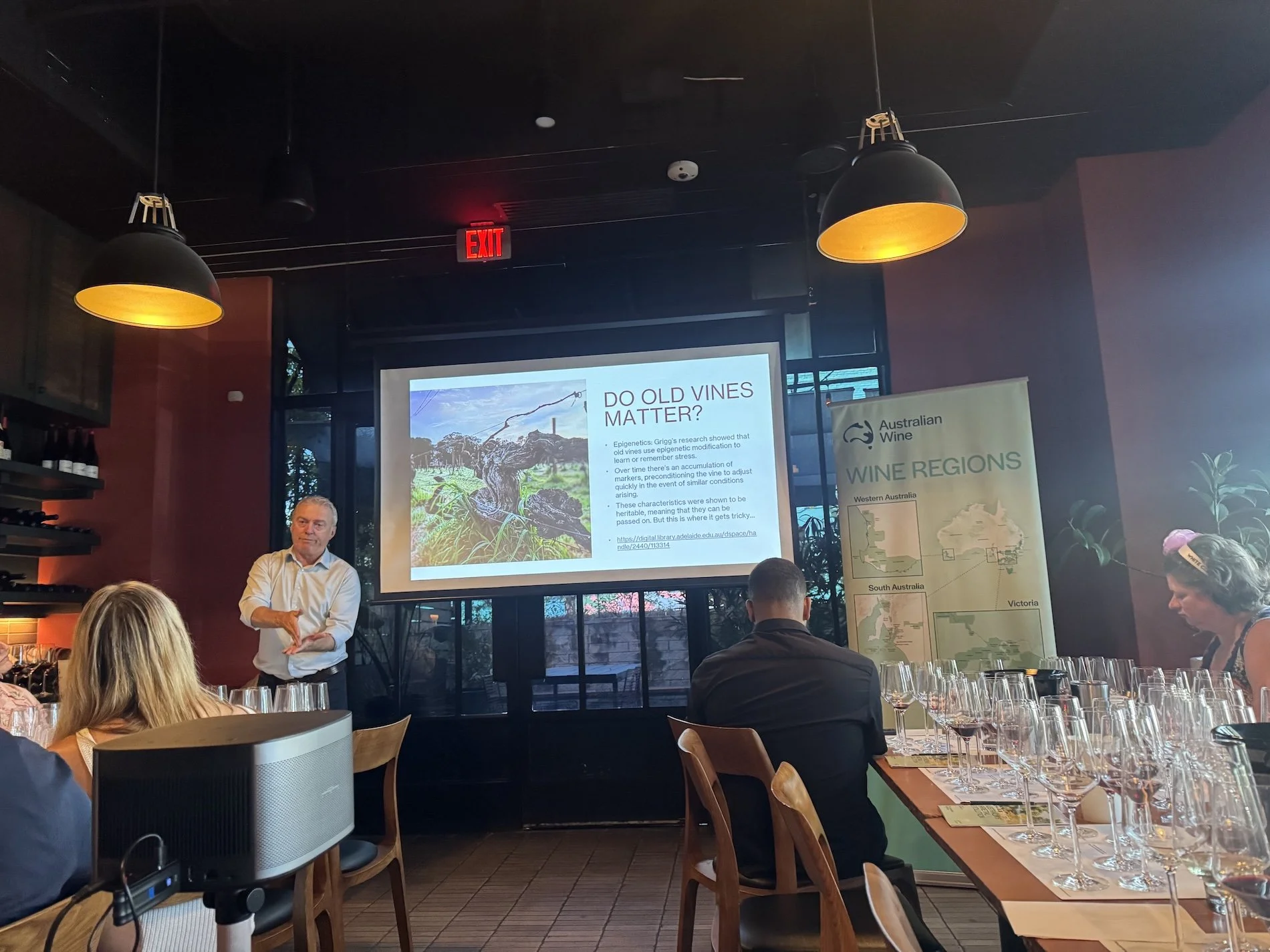
Then Davidson put up a slide asking whether old vines actually matter, and the answer was not the one I expected.
The romantic version says old vines produce less fruit, and less fruit means more concentrated flavor. Research by Dylan Grigg at the University of Adelaide found the opposite on yield. His old vines produced more.
What they had instead was memory. Grigg's work found that old vines use epigenetic modification to record stress. Over decades they accumulate markers that precondition the vine to respond faster when the same conditions come around again, a drought or a heat spike it has survived before. And those characteristics appear to be heritable, which means they can be passed to new plantings.
So the case for old vines is not really about flavor concentration. It is that a 170-year-old vineyard is a library of everything that has gone wrong in that spot since 1853, and in a warming climate that turns out to be worth protecting. The cheapest wine on the whole tasting list makes the point: Hewitson's 'Baby Bush' Mourvèdre is nineteen dollars, and the vines are propagated from Old Garden.
The screw cap revolution Australia invented, abandoned, and then won
Nearly every Australian wine you pick up has a screw cap, and there is a much better story behind that than "it's cheaper."
In 1964, a man named Peter Wall, then Production Director at Yalumba, approached a French company called Le Bouchage Mécanique about building a better seal. Cork taint was ruining wine and nobody had a fix. The result was the Stelvin closure, trialled in 1970 and 1971 on Swiss Chasselas and first used commercially by a Swiss winery in 1972.
Yalumba brought it home, and from 1973 a group including Penfolds, Hardys, Seppelt, Brown Brothers and Tahbilk worked on proving the concept, going commercial in 1976.
Then it failed. Australian and New Zealand drinkers rejected it as cheap, and by the early 1980s it had been largely phased out.
It came back in July 2000, and it came back through Riesling. A group of thirteen Clare Valley winemakers, led by Jeffrey Grosset, decided the aromatic freshness of their Riesling was worth more than the tradition of cork, and bottled a portion of their production under Stelvin together. Riesling is the variety most punished by cork taint, so it was both the best test case and the most exposed one.
They were right, the wines aged beautifully, and today roughly 90% of Australian wine is sealed under screw cap. An Australian winery commissioned the thing, Australia rejected it, and Australia brought it back and convinced the rest of the world. I drank two Yalumbas that afternoon without knowing any of that.
The Prosecco that has to call itself Glera
One of the whites was a Glera from Mitolo in McLaren Vale, and the name on that label is the subject of a twenty year international argument.
Prosecco used to be a grape. In 2009, Italy renamed the grape Glera within the EU and made Prosecco a protected place name instead, which meant nobody outside northeastern Italy could legally use it. Australia objected, on the grounds that it had been growing a grape called Prosecco since 1999 and had a national industry built on it. In 2013 Australia won that challenge domestically.
The compromise arrived this past March in the EU-Australia trade agreement. Australian producers can keep using Prosecco at home, but the name phases out on exports over the next ten years, with new labelling rules starting within two. Which is why the bottle in front of me said Glera.
Davidson's aside was the part I liked best. Australian producers could have leaned harder on the Prosecco name while they still can, and mostly have not bothered, because who exactly is going out looking for an Australian Prosecco? It was very good, incidentally. Eleven percent alcohol and thirty five dollars.
How to tell if an Australian wine was sustainably grown
This one is genuinely useful at the shelf, because Australia has done something most countries have not.
Sustainable Winegrowing Australia is a single national program rather than a patchwork of competing certifications. Its members farm about 102,000 hectares, which is roughly 70% of Australia's entire vineyard area. Of its 1,995 members, 1,569 have completed certification.
That distinction matters. Only certified members can put the trust mark on the bottle, so the thing to look for on the back label is the mark itself, not a producer describing itself as a member. Sixteen of the twenty five wines we tasted carried it, which is about 64% and tracks closely with the national figure. The lineup was not curated to make sustainability look good. That is simply what the industry looks like now.
What I would actually go buy
If you want to start somewhere, start cheap and strange rather than expensive and safe.
A Fiano or a Vermentino from McLaren Vale or the Riverland will cost you somewhere between eighteen and thirty five dollars and will not taste like anything else in your rack. An Australian Grenache in the twenty to twenty five dollar range is, to my mind, one of the best values in wine right now, precisely because so few people are looking for it. And if you find an Australian bottle labeled Syrah instead of Shiraz, buy it, because someone made a deliberate decision about style and wants you to know.
If the wine aisle is where you usually freeze up, my free guide walks through how to decode any bottle in about thirty seconds, and every wine I have ever recommended lives in one running list organized by style and by store.
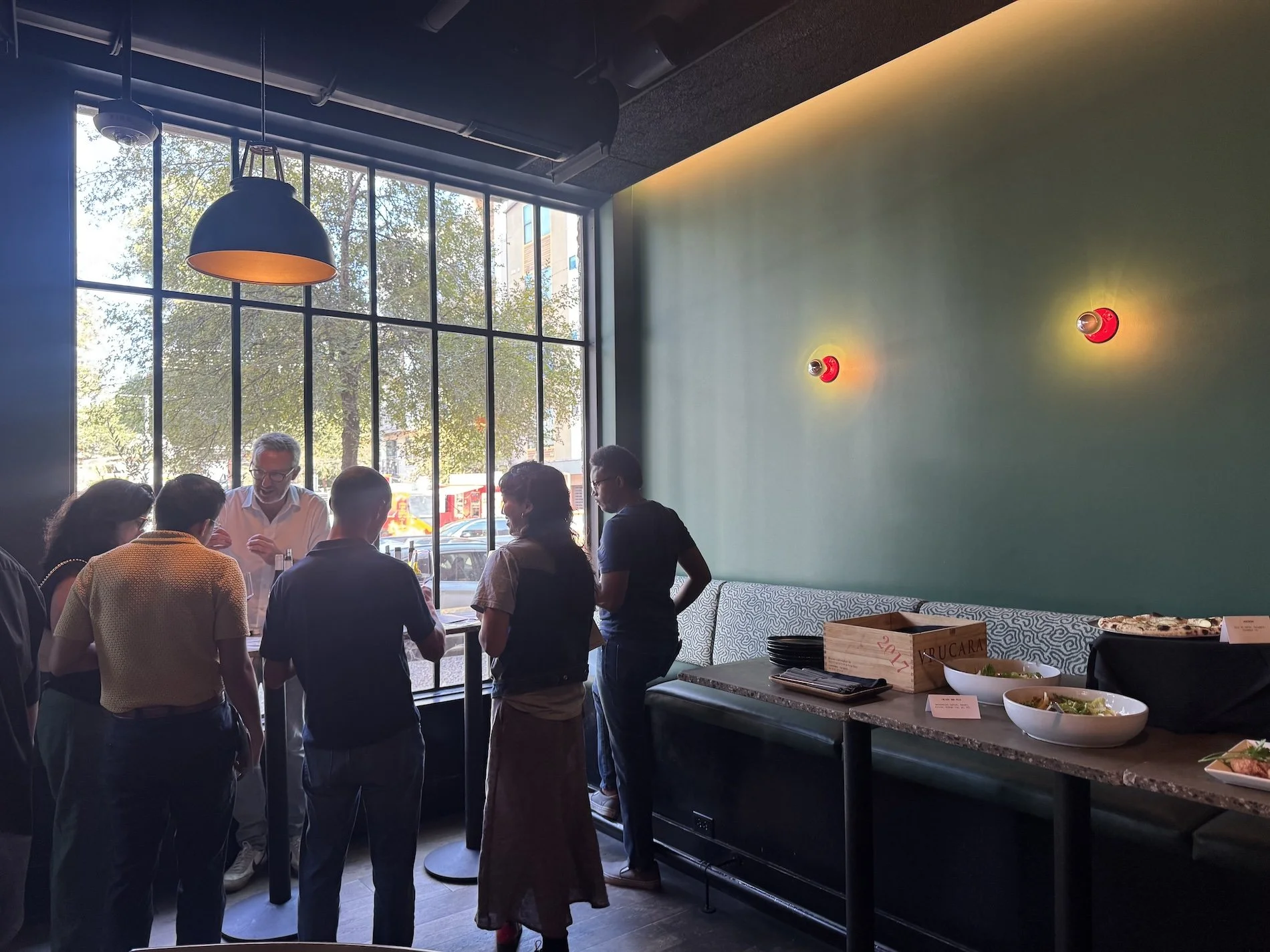
Attendees at the Style Shifts Australian wine seminar at Il Brutto in Austin, Texas
The thing worth remembering
A country spent forty years becoming famous for one grape, discovered that fame had turned into a ceiling, and has spent the last twenty quietly planting its way out.
Almost none of that has reached the average wine shelf conversation yet, which is exactly why it is a good time to be curious about it. If you have written Australia off as jammy reds, the wines that would change your mind are sitting there at twenty five dollars waiting for someone to pick them up.
That is the whole reason I love a comparative tasting, and it is why tasting side by side beats reading about it every single time. If you want to put a flight like this together for your own group, here is how to host one without the fuss, or I am happy to build one for you and bring the bottles.
Style Shifts: Australia's Varietal Evolution was presented by Mark Davidson of Wine Australia at Il Brutto, Austin, Texas, on September 22, 2026. All prices are US retail as listed in the seminar materials.
Jennifer Strachan is the founder of Wine, Uncomplicated. WSET II certified, Texas Wine Ambassador, and has been making wine in West Texas since 2015.