
You're in the aisle holding a bottle you've now turned over three times, reading a back label that says something about rolling hills and generations of family tradition, and you still have absolutely no idea what the wine is going to taste like.
That's not you failing at wine. That's the label doing exactly what it was designed to do, which is sell you something rather than inform you.
Here's the good news. Every bottle has a handful of pieces of information that are legally required to be there, and those are the ones that actually tell you something. Once you know where to look, learning how to read a wine label takes about thirty seconds and completely changes how you shop.
Clue 1: Whether it leads with a grape or a place
This is the single most useful thing on the bottle, and it's the difference between wines from Europe and wines from pretty much everywhere else.
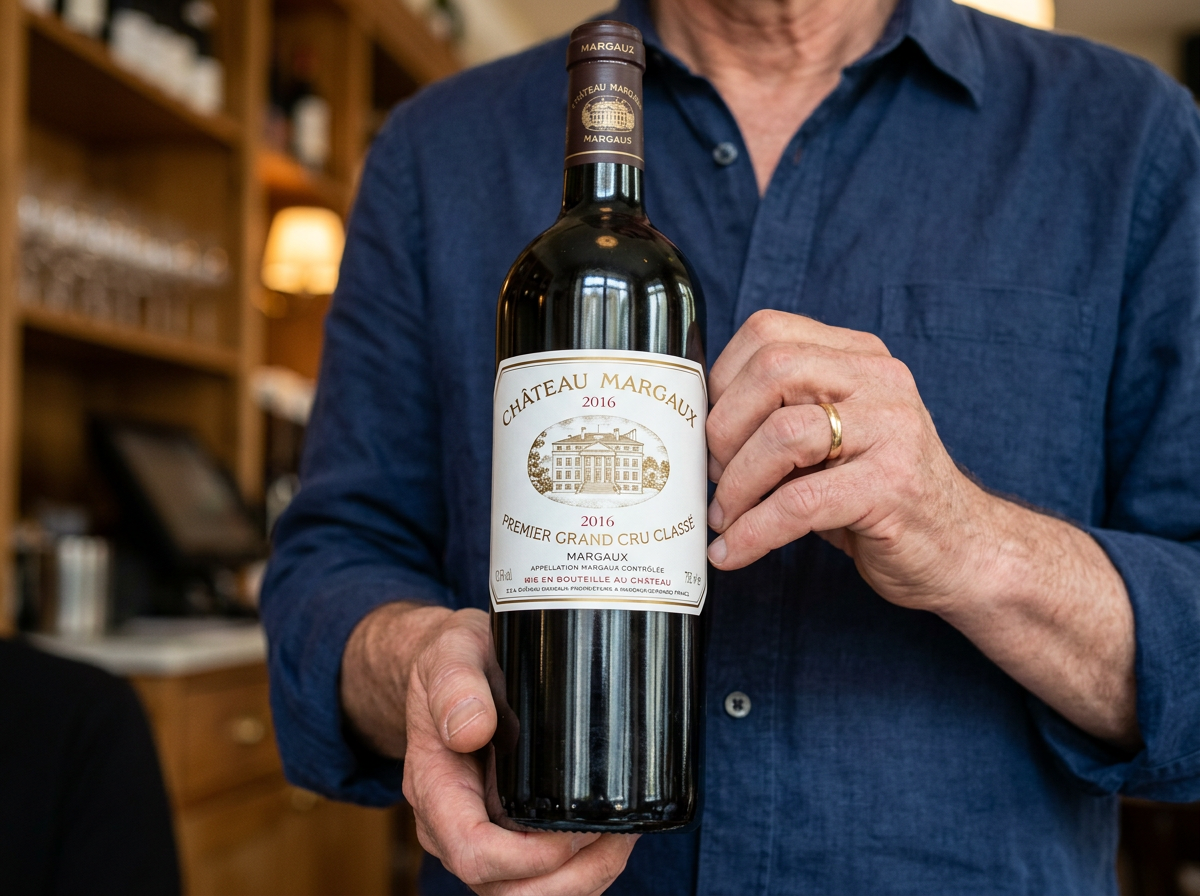
New World wines (the US, Australia, New Zealand, Chile, Argentina, South Africa) put the grape front and center. Cabernet Sauvignon. Pinot Grigio. Malbec. You know what you're getting because they told you.
Old World wines (France, Italy, Spain, Portugal, Germany) usually put the place front and center and assume you know what grows there. Sancerre is Sauvignon Blanc. Chablis is Chardonnay. Rioja is mostly Tempranillo. Chianti is Sangiovese.
This is why so many people decide they don't like French wine when what actually happened is they had no idea what they bought. If a label gives you a place instead of a grape, that's your cue to look it up, and after about five bottles you'll start recognizing the ones you like.
Clue 2: The alcohol percentage is a style clue, not a strength warning
Almost nobody uses this one, and it's the fastest read on the whole bottle.
Alcohol comes from sugar, and sugar comes from ripeness, so the percentage is basically telling you how warm and sunny it was where those grapes grew. That in turn tells you how the wine is going to feel.
Anything under 11.5% is going to be lighter and crisper, often with more acidity and sometimes a touch of sweetness. Think Vinho Verde, German Riesling, or the frizzante rosés that clock in around 10.5%. These are your patio wines and your "I want a glass but not a whole situation" wines.
Anything at 14% or above is going to be fuller, richer, and warmer on the finish. Big California Cabernet, Zinfandel, Southern Rhône reds. Not better or worse, just a different experience and a different food match.
The middle, roughly 12% to 13.5%, is where most of the world's wine lives. Balanced, food friendly, safe bet.
Clue 3: The vintage matters less than you've been told
The vintage is just the year the grapes were picked, and for the overwhelming majority of bottles under about twenty five dollars, it barely moves the needle.
Where it does matter is freshness. If you're buying a white, a rosé, or a sparkling wine, you generally want something from the last one to three years, because those styles are built to be drunk young and bright, not aged into something contemplative.
For reds in that same price range, a year or two of age is fine and sometimes better. And if you're buying something expensive from a region with unpredictable weather, then yes, vintage becomes a real conversation. But that's a different shopping trip.
If you're standing in the aisle right now, the practical version is this: for whites and rosés, grab the most recent year on the shelf.
Clue 4: The producer is the name worth remembering
The grape tells you the style. The region tells you the climate. But the producer is the person making the actual decisions, and it's the only name on the bottle that will help you next time.
If you find a Chardonnay you love, the useful takeaway usually isn't "I like Chardonnay." It's "I like what this producer does." Write the name down. Look for it on their other bottles, because a winery that makes a white you love very often makes a red you'll love too.
This is the habit that turns random wine buying into something that compounds. I keep a running list of every bottle I've recommended for exactly this reason, organized by style and by store, so you can find the producer again instead of trying to remember what the label looked like.
Clue 5: The words that legally mean nothing
Here's where labels get slippery, and it's worth knowing which terms carry weight and which are pure decoration.
In the United States, "Reserve" means nothing. There is no legal standard behind it. A winery can print it on anything, and plenty do, because it reliably adds a few dollars to the price. Same goes for "Old Vine," "Winemaker's Select," "Handcrafted," and "Limited Release."
But in Spain and Italy, the equivalents are strictly regulated. A Rioja labeled Reserva has to have aged for a minimum period with a required stretch in oak, and Riserva works similarly in Italy. Those words are a real promise about how the wine was made.
A few US terms do mean something. "Estate Bottled" requires that the winery grew the grapes on its own land in the same appellation and made and bottled the wine there. And any single vineyard name on a label is a genuine specificity claim.
So the rule of thumb is simple. Vague adjectives are marketing. Specific places, specific years, and regulated aging terms are information.
Putting all five together in thirty seconds
Pick up the bottle. Is it a grape or a place? What's the alcohol percentage, and is that light, medium, or full? Is the vintage recent enough for the style? Who made it, and is that a name you've seen before? And is anything on the front label a real claim or just a nice adjective?
That's it. That's the whole framework, and it works on a seven dollar bottle at Trader Joe's just as well as it works on a wine list at a restaurant.
The reason this matters isn't that you'll suddenly become a wine expert. It's that you'll stop buying by accident. And once you know what you're actually choosing, the next step is figuring out what you like about it, which is what tasting wine without the fuss is really for. If you're planning to share what you find, hosting a wine tasting party is a lot easier when you can explain why you picked each bottle.
Take the cheat sheet with you
Reading about this is one thing. Standing in front of two hundred bottles with a dinner party in three hours is another.
That's why I put together Stop Guessing in the Wine Aisle, a free guide that gives you this framework plus the exact question to ask at any wine shop, the hosting formula that covers about 90% of guests, and why the price tag is the least reliable signal on the bottle. No charts to memorize and no pretending you know what terroir means.
Grab the free guide here, and if you'd rather learn this with a glass in your hand and someone answering your questions in real time, that's what the tastings are for.