
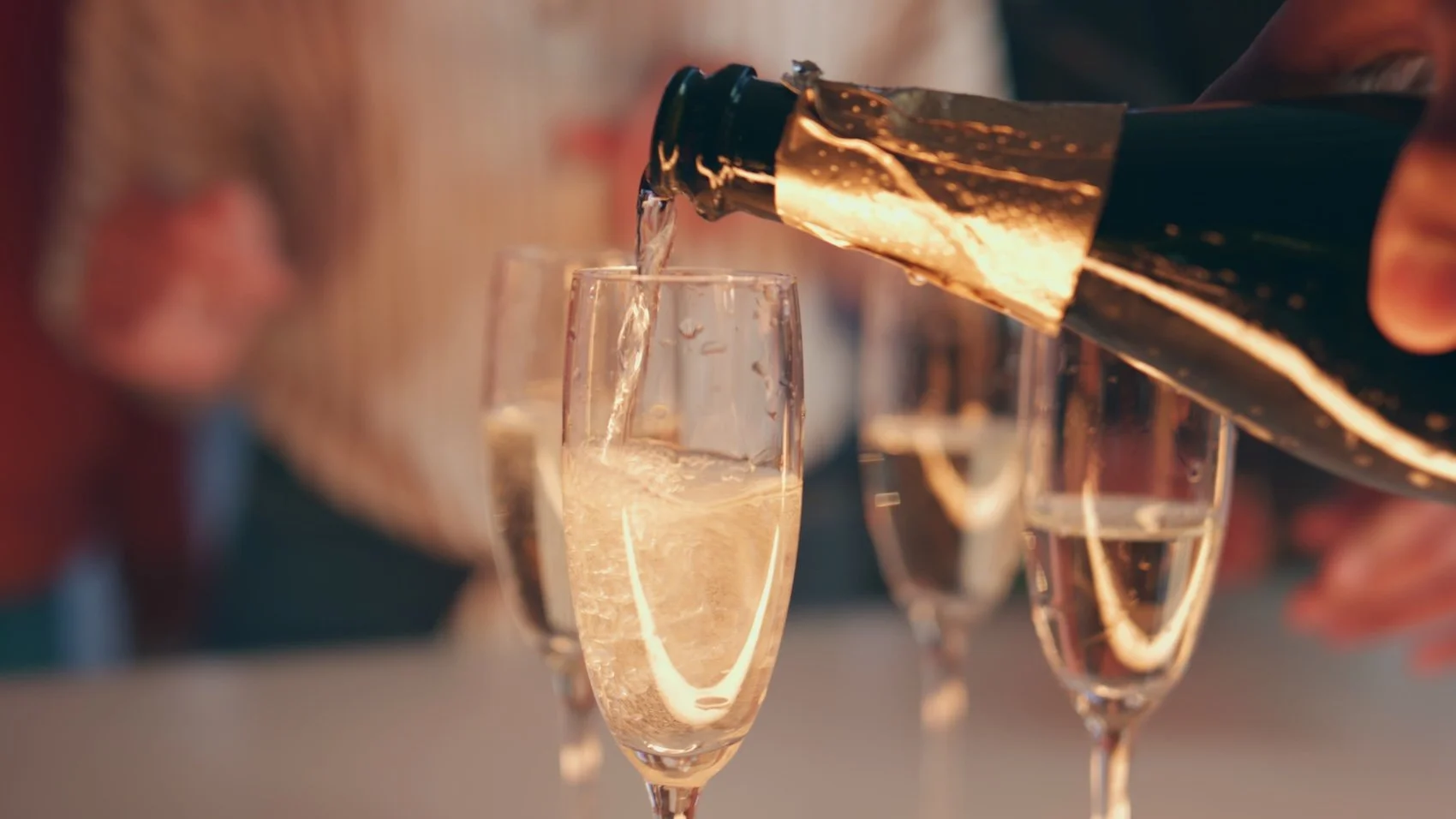
You've been at this party. It's a few minutes to midnight, or it's a wedding, or it's somebody's promotion, and the bottle goes around and someone with a glass in hand says the line: "Come quickly, I am tasting the stars." Everybody nods, because it's a beautiful thing to say and the bubbles are already doing their job.
Here's the thing. The blind old monk never said it. That line first showed up in a print advertisement in the late 1800s, roughly a hundred and seventy years after Dom Pérignon died, and it worked so well that we're still repeating it at parties.
I'm not telling you this to ruin the toast. I'm telling you because the true story of who invented champagne is stranger and funnier than the myth, and it involves exploding glass, a chemistry paper read to a room of Englishmen, and two widows who ran the industry better than anyone had before them.
The monk's actual job was to get rid of the bubbles
Pierre Pérignon was real. He was a Benedictine monk, born in 1638, and he took over the cellars at the Abbey of Hautvillers in 1668 and stayed in that job until he died in 1715. All of that is true.
What's not true is that he was chasing effervescence. In his lifetime, bubbles in wine were a defect, and an expensive, dangerous one. Champagne sits at the cold northern limit of where grapes will ripen, so fermentation would stall out in winter, the wine would get bottled, and then spring warmth would wake the yeast back up inside a sealed bottle with nowhere for the gas to go.
Bottles exploded. Not occasionally, either. Cellar workers wore protective masks because one bottle going off could set off a chain reaction down the rack, and the locals had a name for the stuff: vin du diable, the devil's wine.
Pérignon spent his career trying to fix that. What he actually contributed was the boring, difficult, actually important work: blending fruit from different vineyards into something better than any single plot could give you, pressing dark grapes quickly and gently so the juice stayed pale, pruning hard, picking in the cool of the morning, sorting out the bruised fruit. That skill, the blending especially, is still the central craft of the region. He was a very good winemaker who would have been horrified to have his name on a bottle of sparkling wine.
An Englishman wrote it down first, and he had better bottles
On December 17, 1662, a physician and scientist named Christopher Merret presented a paper to the Royal Society in London called "Some Observations concerning the Ordering of Wines." In it, he described how English merchants were adding sugar and molasses to wine to make it "drink brisk and sparkling."
That's six years before Pérignon even started his job in the cellars. Merret wasn't describing an accident, he was describing a deliberate technique, which means the first written record of making wine sparkle on purpose is English, not French.
The English also had the equipment. Their coal-fired glass furnaces produced bottles far stronger than anything coming out of France at the time, and they had a steady supply of Portuguese cork. So while the French were losing half a cellar to shrapnel, the English could actually hold the pressure in.
If you want one piece of trivia that will stop a table cold, that's the one.
Champagne only became a business when the law changed
For a long time, the thing that kept sparkling wine from becoming an industry wasn't the winemaking. It was shipping. French wine legally moved in casks, and you cannot ship a wine under pressure in a cask.
That changed on May 25, 1728, when a royal decree finally authorized shipping Champagne's wines in baskets of bottles. Fourteen months later, in September 1729, Nicolas Ruinart opened the first house built specifically around sparkling wine, and the others followed: Moët in 1743, Clicquot in 1772.
Even then it was a luxury gamble. Nobody could predict how much pressure a given bottle would build, and losses of fifty percent were normal in a bad year. Sparkling champagne wasn't the region's dominant style until the middle of the 1800s, which is worth sitting with for a second. For most of its history, champagne was a still wine.
Two widows and a pharmacist built the champagne you actually drink
Barbe-Nicole Clicquot was widowed at twenty-seven and took over her husband's house at a time when women did not run businesses. Around 1818, working with her cellar man Antoine Muller, she took a kitchen table, had holes drilled in it at an angle, and used it to tip bottles neck-down so the spent yeast would collect in the neck where it could be expelled.
That's why your glass is clear instead of cloudy. Every bottle of traditional-method sparkling wine in the world still goes through some version of that process, and it started with a table in a cellar in Reims.
Then, in the 1830s, a chemist named Jean-Baptiste François worked out how to measure the sugar in a wine before bottling so you could calculate the pressure instead of praying about it. Breakage went from catastrophic to routine, and champagne got cheap enough for people who weren't royalty.
And Madame Pommery, chasing the British market, created the Brut designation in 1876 for the 1874 vintage. Before that, champagne was sweet, often dessert-sweet. The dry style you think of as the classic, correct, sophisticated way to drink champagne is a Victorian English preference that a French widow decided to build a product around, and it stuck.
Why the myth won anyway
So why does a monk who tried to prevent bubbles get all the credit? Because the name was worth something. It passed to Moët in 1927 as part of a family wedding arrangement, went onto a prestige bottle, and first sold in 1936, by which point the marketing had a hundred years of head start on the facts.
A blind monk running into a cellar shouting about stars is a story you can put on a label. "A chemist figured out how to measure sugar in the 1830s" is not.
I'd argue the real story is more useful to you, though, and this is the part I care about. Champagne is not a sacred object handed down by a genius. It's a cold-climate accident that a lot of stubborn, practical people spent two hundred years turning into something reliable. The mystique came later, on purpose, as marketing.
Which means you're allowed to just drink it. You don't need to earn it, you don't need a special occasion, and you certainly don't need to know the difference between a Blanc de Blancs and a Blanc de Noirs before you're permitted to enjoy the glass in your hand. That kind of gatekeeping is exactly what I think wine education should be moving away from, and it starts with realizing how much of the reverence was invented by an ad agency.
What to do with this on a Tuesday
Open something sparkling this week for no reason. Pay attention to whether it tastes dry or a little sweet, whether the bubbles feel fine and persistent or big and foamy, and whether you like it. That's the whole assignment, and if that sounds too simple, I'd point you to how to actually taste wine, where the short version is that nobody is grading you.
If you do want to make an occasion of it, a sparkling flight is one of the easiest tastings to host, because the differences between a champagne, a crémant, a cava, and a prosecco are obvious even to people who swear they can't taste anything. I've written a whole walkthrough on hosting a tasting without the fuss if you want a format to follow.
And if you'd rather not build it yourself, that's what I'm here for. I put together tastings for people who want their friends to have a great night without anyone having to perform expertise, and you can see how that works for wine lovers or just book a consult and tell me what you're planning.
You already know more about champagne than the person at the party quoting the ad. Go pour something.