
Here's the thing about summer wine advice: most of it isn't actually helpful.
You get a list of forty bottles, three of which are available in your city, and none of which come with any explanation of why they're good for summer specifically. So you end up buying whatever's on sale and hoping for the best.
This is not that list.
This is a practical, opinionated guide to the wines that actually belong in your fridge right now, whites, rosés, and yes, chilled reds, for people who want to drink well without spending an afternoon thinking about it.
First, Why Does Summer Even Change Things?
It does, and it's simple. When it's hot outside you want wine that feels refreshing, high acidity, lower alcohol, and something that doesn't coat your mouth with tannins. The same Cabernet that tastes great in January feels heavy and muddy in July.
The good news is there are entire categories of wine built exactly for this moment. You just need to know where to look.
The Whites
Albariño
If you haven't had Albariño yet, this summer is your sign. It's from the Rías Baixas region in northwestern Spain, right on the Atlantic coast, and it tastes like it. Saline, stone fruit, citrus, really bright acidity and usually under $20. It's everything you want in a summer white and it's genuinely underrated compared to how good it is.
Look for it at HEB or Total Wine. It's one of those bottles that's easy to find and impossible to be disappointed by.
Vinho Verde
I've said it before and I'll say it again: Vinho Verde is the wine for people who think they don't like wine. It's from northern Portugal, only about 9-11% alcohol, slightly fizzy, and really light. The name means green wine in Portuguese, which refers to the young grapes not the color.
Broadbent is the bottle I always come back to. Around $10 at HEB. Put it in the fridge and don't overthink it.
Assyrtiko
This one is for when you want to impress someone without spending a lot of money. Assyrtiko is from Santorini, Greece, grown in volcanic ash soil, and it has some of the highest natural acidity of any white wine in the world. It's bone dry, mineral, saline, and honestly unlike anything else you'll try this summer.
The Hermes Assyrtiko is $14.99 at Total Wine. Pick it up.
The Rosés
The rosé market has gotten a little noisy, so here's the short version of what to look for: dry, pale, and from a region that knows what it's doing.
Sancerre Rosé
We covered this one and it deserves repeating. Sancerre makes a rosé from 100% Pinot Noir and it is one of the best deals hiding in plain sight. You usually see Sancerre rosés for $25-35 because of the region, but the 2024 Moulin Jamet from Trader Joe's is $15.99. It's elegant, dry, saline, and pairs with everything.
Pet Nat Rosé
Pet Nat, short for Pétillant Naturel, is naturally sparkling wine made by the oldest method in existence. It predates Champagne. It's a little wild, a little unpredictable, and a lot of fun. The Time Warp Pet Nat Rosé from Total Wine is $12.99 and it is a perfect summer bottle.
One thing to know: Pet Nat can look a little cloudy. That's normal. It's just natural sediment from fermentation and it's totally fine.
The Chilled Reds
This is where I lose some people. But stay with me.
The idea that all red wine should be served at room temperature is based on a European cellar temperature of around 60-64 degrees. Not your living room in July. When red wine is too warm the alcohol gets pronounced, the fruit falls flat, and the whole thing tastes a little muddy.
For lighter reds especially, 20-30 minutes in the fridge before opening genuinely transforms the wine. Brighter fruit, better acidity, more refreshing in every way.
Beaujolais-Villages
Beaujolais is made from the Gamay grape in the Beaujolais region of France, and it's built differently from most reds. The winemaking style keeps it really fruit forward, light on tannins, and meant to be drunk right now rather than aged. It's basically the anti-Cabernet.
The Laurent Delaunay Beaujolais-Villages is around $14 at Total Wine. Pop it in the fridge 30 minutes before you open it and you will not regret it.
Dry Lambrusco
Sparkling red wine sounds like a gimmick until you understand where it comes from. Lambrusco is from Emilia-Romagna in northern Italy, the food capital of the country. Prosciutto, Parmigiano, mortadella, Bolognese. The wine evolved specifically to cut through all of that richness, which means the bubbles and tannins do something no still wine can.
The dry version is nothing like the sweet Riunite at the grocery store. It's bright, fizzy, dark cherry, light tannins, and served cold. The Lambrusco Rosso dell'Emilia is $14.50 at HEB and it's one of my favorite summer finds right now.
The Cheat Sheet
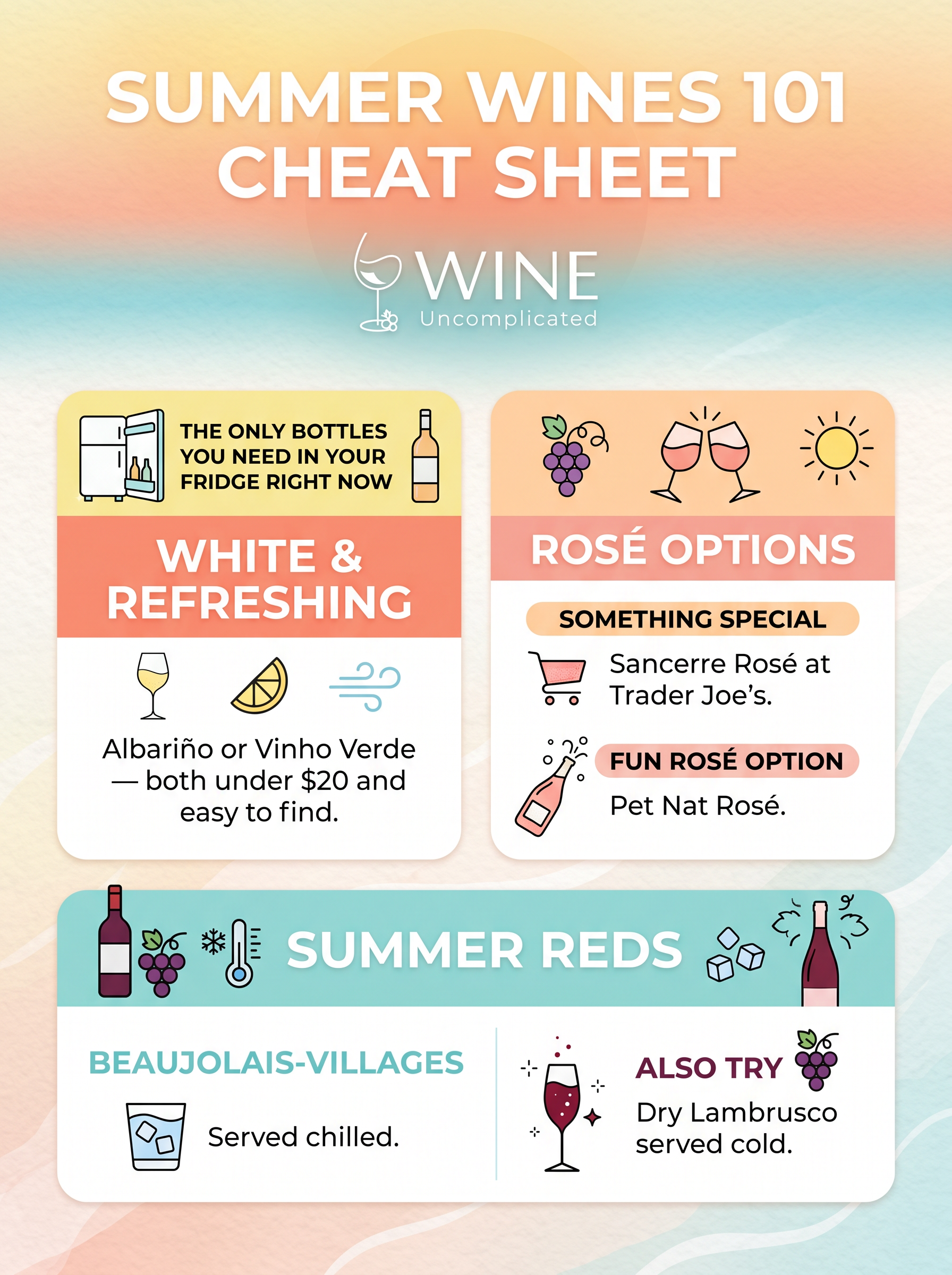
If you're standing in the wine aisle right now and just need an answer, here it is:
For something white and refreshing: Albariño or Vinho Verde. Both under $20, both easy to find.
For rosé: Sancerre Rosé at Trader Joe's if you want something a little special. Pet Nat Rosé if you want something fun.
For a red that actually works in summer: Beaujolais-Villages chilled, or dry Lambrusco cold.
That's it. Six bottles, every situation covered. The only rule is that it should be cold enough and easy enough that you actually enjoy drinking it.
That's what summer wine is for.